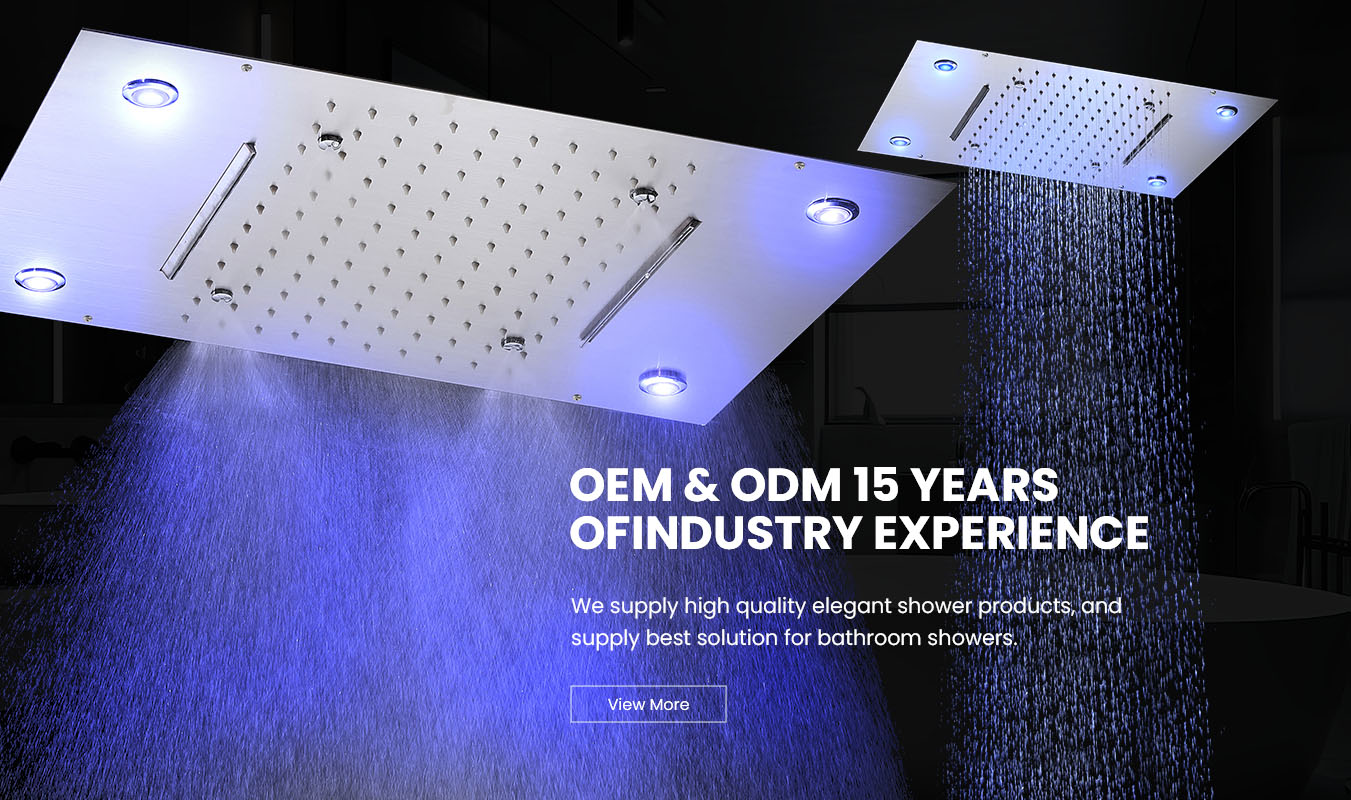
In mass shower production, quality is built on repeatability. A shower components manufacturer cannot rely on final inspection alone, because dimensional drift, surface defects, and sealing failures usually begin much earlier in the process. For export-oriented programs, material tolerance and defect rate control directly affect installation fit, appearance consistency, and after-sales cost. EMYSA focuses on Brass Shower Heads, Stainless Steel Shower Heads, concealed shower systems, Hand Showers, and Shower Head Fittings, which gives it a practical manufacturing base for OEM shower components, bulk shower components supply, and long-term shower system production.
Manufacturing process overview
The control logic starts with the full production flow. In a factory environment, shower parts manufacturing usually moves through raw material selection, casting or forming, CNC machining, polishing, surface finishing, assembly, function testing, and final packaging. Each stage has its own tolerance window. If thread size varies too much in machining, assembly torque becomes unstable. If polishing removes too much material, the finished part may still look good but fail later in sealing or fitting. This is one of the biggest differences in a manufacturer vs trader comparison. A manufacturer can monitor tolerance and defect causes at the station level, while a trader often depends on feedback from outside factories.
Material standards used
Material standards used in shower production must match the target market. For brass components that contact water, lead control is a major requirement. The U.S. EPA states that lead-free plumbing products must meet a weighted average lead content of not more than 0.25 percent across wetted surfaces. In the European market, REACH is the main law for protecting human health and the environment from chemical risks, so raw material declarations and coating control are part of export market compliance. For a factory like EMYSA, this means incoming inspection is not just about appearance. It must confirm alloy quality, stainless steel grade, and finishing compatibility before production begins.
Quality control checkpoints
The most effective quality control checkpoints are placed across the line. Raw materials should be checked first for grade consistency and visible defects. During machining, dimensions, threads, flatness, and sealing surfaces need regular inspection. After polishing and coating, the focus shifts to appearance uniformity, adhesion, and corrosion resistance. EMYSA states that one of its concealed shower mixer products uses SUS304 stainless steel with a brass body and has passed salt spray testing for at least 96 hours, which reflects the importance of finish durability in humid bathroom environments. In functional testing, leak prevention and operating stability are essential. WRAS approval listings for shower outlets show common benchmark conditions such as maximum working pressure of 5.0 bar and maximum operating temperatures of 60°C or 85°C, depending on product type, which shows why pressure and thermal verification are central to defect rate control.
OEM / ODM process and bulk supply considerations
In the OEM / ODM process, tolerance control starts before mass production. Drawing review, sample validation, finish approval, packaging confirmation, and pilot run checks all reduce the chance of repeated defects in large orders. This is especially important when the project includes custom dimensions, private labeling, or special finish targets. Bulk supply considerations also go beyond unit price. Stable replenishment requires the same tolerance standard across different batches, not just in the first order. That is why project sourcing checklist items should include material traceability, in-process inspection records, sample retention, packaging validation, and export documentation readiness. A direct factory usually handles these tasks with more speed and visibility than a sourcing intermediary.
For buyers comparing suppliers, low defect rates usually come from disciplined process control rather than broad catalogs. The stronger partner is the one that can manage brass and stainless steel tolerances, build clear checkpoints into shower parts manufacturing, and maintain export-ready standards across every batch. EMYSA’s manufacturer-based model is better suited to support OEM shower components development, controlled mass production, and more reliable bulk delivery for regulated markets.