
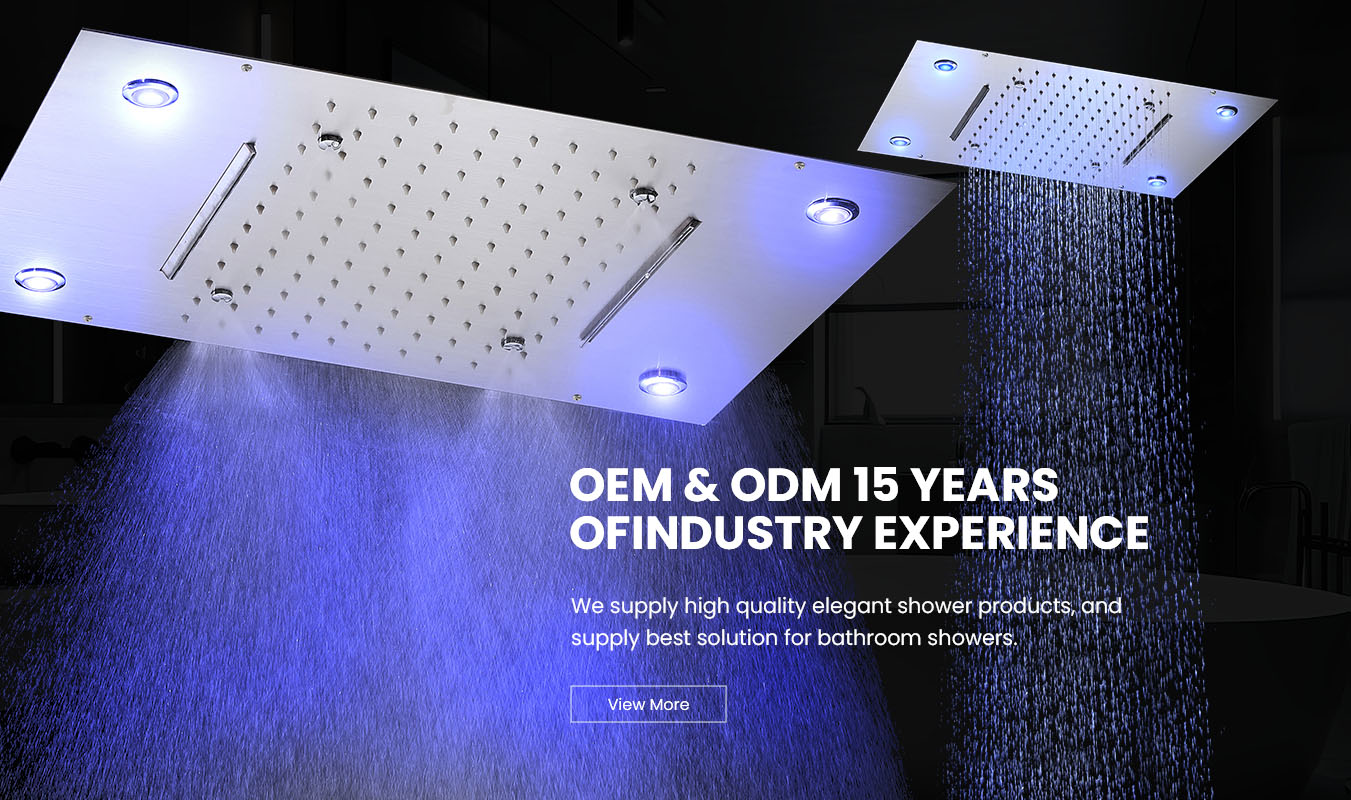
A leaking shower head is not only a maintenance issue but also a signal of deeper product quality, sealing structure, and material consistency. From a manufacturing perspective, solving leakage requires understanding both installation factors and product engineering standards.
Based on professional shower system production experience, this guide explains how to fix leakage while also helping buyers evaluate supplier capabilities for long-term reliability.
Common Causes of Shower Head Leakage
In most cases, leakage originates from three technical areas:
1. Seal Failure in Connection Points
Worn-out rubber washers or gaskets
Poor thread precision between shower arm and head
Inconsistent sealing caused by low-grade materials
2. Internal Structure Defects
Uneven water distribution chamber
Poorly molded nozzle outlets
Weak welding or assembly of internal components
3. Water Pressure Imbalance
Excessive pressure beyond standard tolerance
Lack of pressure regulation in the valve system
From a manufacturing standpoint, these issues are often linked to production precision and material standards rather than just installation mistakes.
Step-by-Step Solution to Stop Leakage
Inspect and Replace Sealing Components
Remove the shower head and check the washer. Industrial-grade EPDM or silicone seals are recommended due to higher resistance to heat and pressure.
Apply Professional Thread Sealing
Wrap PTFE tape evenly around threads to ensure airtight connection. In manufacturing, thread tolerance is typically controlled within ±0.05 mm to avoid leakage risks.
Clean Internal Mineral Deposits
Calcium buildup affects sealing surfaces. Soaking in mild acidic solution restores nozzle performance and reduces micro-leak paths.
Check Pressure Compatibility
Standard shower systems are designed for 0.1–0.5 MPa water pressure. Exceeding this range can cause continuous dripping even in high-quality products.
Manufacturer vs Trader: Why It Matters
When dealing with leakage issues at scale, the supplier type directly impacts product reliability.
| Criteria | Manufacturer | Trader |
|---|---|---|
| Production Control | Full control over materials & QC | No control over production |
| Custom Sealing Design | Available (OEM/ODM) | Limited |
| Technical Support | Engineering-based | Sales-based |
| Consistency in Bulk Orders | Stable | Variable |
A factory-based supplier ensures consistent sealing performance across batches, which is critical for hospitality or residential projects.
OEM / ODM Process for Leak-Proof Shower Systems
A professional manufacturer typically follows a structured development process:
Requirement Analysis
Water pressure standards by target market
Installation compatibility
Surface finish and corrosion resistance
Engineering Design
Internal water flow simulation
Seal structure optimization
Thread precision calibration
Prototype Testing
Pressure resistance testing up to 1.6 MPa
100,000+ cycle durability tests
Leakage detection under continuous flow
Mass Production
CNC machining for thread accuracy
Automated polishing and finishing
Assembly under controlled torque standards
This process ensures that leakage risks are minimized before products reach the market.
Manufacturing Process Overview
A high-quality shower head involves multiple precision-controlled steps:
Raw material selection: brass and stainless steel for corrosion resistance
Gravity casting or tube forming
CNC machining for threads and internal chambers
Surface treatment such as electroplating or PVD coating
Final assembly with calibrated sealing torque
Factories located in major plumbing production hubs adopt advanced European-standard manufacturing processes and strict dimensional control.
Quality Control Checkpoints
To prevent leakage, manufacturers implement multi-stage inspection systems:
Incoming Material Inspection
Chemical composition verification
Corrosion resistance testing
In-Process Quality Control
Thread gauge inspection
Seal fitting verification
Final Testing
Air pressure leak testing
Water flow simulation testing
Surface finish inspection
Products exported to Europe and Australia often comply with WRAS or similar standards, ensuring water safety and sealing reliability.
Material Standards Used
Material selection directly impacts leakage resistance:
Brass (Cu≥59%): High strength, stable threading
304 Stainless Steel: Corrosion-resistant, long service life
Silicone / EPDM Seals: High elasticity and temperature resistance
Using substandard materials often leads to deformation, which compromises sealing over time.
Bulk Supply Considerations
For large-scale procurement, leakage control must be evaluated across batches:
Consistency in sealing performance
Stable supplier production capacity
Uniform material sourcing
Batch-level testing reports
Typical MOQ ranges from 200–500 units depending on customization, with lead times of 30–45 days for standard production cycles.
Project Sourcing Checklist
When sourcing shower heads for projects, consider:
Thread compatibility with global standards
Pressure resistance certification
Anti-leak structural design
Surface durability for humid environments
Supplier capability for OEM customization
This ensures fewer maintenance issues post-installation.
Export Market Compliance
Reliable manufacturers align with international requirements:
WRAS certification for water safety
European material compliance standards
Pressure and durability testing protocols
Export-oriented production ensures compatibility with plumbing systems across multiple regions.
Conclusion
Stopping a leaking shower head is not only about replacing a washer—it reflects the overall engineering quality behind the product. From sealing materials to manufacturing precision, every detail contributes to long-term performance.
For buyers managing bulk procurement or construction projects, choosing a factory with strong production control, OEM capability, and strict quality systems is essential to minimizing leakage issues and maintenance costs over time.